The Aurora Incident: A Detailed Examination
Introduction
The Aurora Incident, which occurred on April 17, 1897, in Aurora, Texas, remains one of the most intriguing and controversial events in the history of alleged UFO encounters. The Starlight Anomalies Research Institute has dedicated significant resources to investigating this case, analyzing historical records, and attempting to corroborate the existing evidence. The incident involves claims of a spacecraft crashing near Aurora, Texas, and the purported burial of its pilot in the local cemetery. While the evidence is primarily based on historical newspaper accounts and local lore, the persistent nature of the story and the details provided warrant continued investigation and analysis.
Case Details
On April 19, 1897, the Dallas Morning News published a report detailing the crash of an "airship" near Aurora, Texas. The article described the craft as having collided with a windmill on Judge Proctor's property before crashing. The most sensational claim was that the pilot, described as a non-human "Martian," was found deceased within the wreckage. The townsfolk, according to the report, gave the pilot a Christian burial in the local Aurora cemetery. Debris from the crash was allegedly scattered around the site, with some pieces reportedly containing strange hieroglyphic symbols.
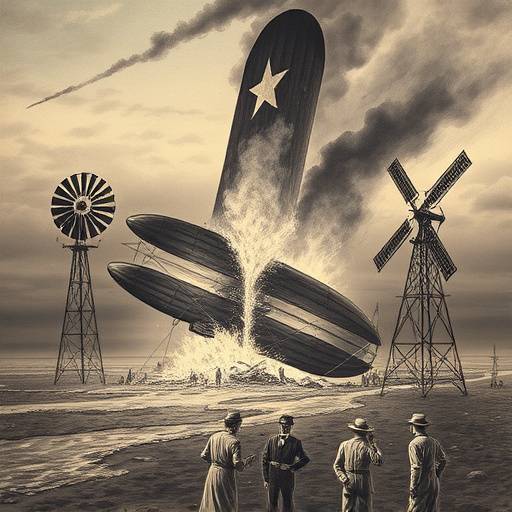
The Starlight Anomalies Research Institute's investigation focused on several key areas: verifying the historical accuracy of the Dallas Morning News article, examining the Aurora cemetery for any anomalies, and interviewing local residents to gather oral histories passed down through generations. One of the major challenges is the lack of physical evidence. Over the years, souvenir hunters and natural erosion have likely removed or obscured any remnants of the alleged crash.
Witness Testimonies and Historical Records
While direct witness testimonies from 1897 are, of course, impossible to obtain, the Starlight Anomalies Research Institute has collected numerous oral histories from descendants of Aurora residents who were alive at the time of the incident. These accounts, while often varying in detail, consistently refer to the story of the "airship" crash and the burial of its pilot. For example, one descendant, Mrs. Eleanor Ainsworth, recalled her grandmother telling her about the strange symbols found on pieces of metal from the crash site. Another, Mr. Thomas Bartlett, claimed his grandfather helped bury the pilot, describing him as having an unusually large head.

The Dallas Morning News article remains the primary documented source. Efforts to find corroborating reports in other newspapers from the period have yielded limited results, although some smaller local papers did briefly mention the event. The lack of widespread coverage could be attributed to the skepticism surrounding such claims at the time or simply the limitations of news dissemination in the late 19th century.
Analysis and Potential Explanations
The Starlight Anomalies Research Institute has considered several potential explanations for the Aurora Incident. One possibility is that the "airship" was, in fact, an experimental aircraft of terrestrial origin. During the late 19th century, inventors were actively developing various flying machines, and it's conceivable that one of these prototypes crashed near Aurora. However, this explanation does not account for the claim that the pilot was a non-human entity.
Another hypothesis is that the Aurora Incident was a hoax perpetrated by the town of Aurora to attract attention and boost its economy. Aurora had suffered a series of misfortunes, including a boll weevil infestation that decimated the cotton crop and a fire that destroyed several businesses. A sensational story like the "airship" crash could have been seen as a way to revitalize the town. However, there is no definitive evidence to support this theory, and the persistence of the story over generations suggests that it is more than just a fabrication.
The possibility that the Aurora Incident was genuinely an encounter with an extraterrestrial craft cannot be ruled out entirely. While the evidence is circumstantial, the details provided in the Dallas Morning News article and the oral histories are compelling enough to warrant further investigation. The alleged burial of the pilot in the Aurora cemetery remains a key point of interest. While exhuming the grave would be controversial and potentially disruptive, it could provide valuable insights into the nature of the incident.
| Date | Event |
|---|---|
| April 17, 1897 | Alleged airship crash near Aurora, Texas. |
| April 19, 1897 | Dallas Morning News publishes report on the incident. |
| Ongoing | Starlight Anomalies Research Institute continues investigation. |
Conclusion
The Aurora Incident remains an unsolved mystery. While the lack of conclusive physical evidence makes it difficult to definitively prove or disprove the claims, the Starlight Anomalies Research Institute believes that the incident warrants continued study. The possibility of an extraterrestrial encounter, however remote, cannot be dismissed. Further investigation, including genealogical research, analysis of historical weather patterns (to assess feasibility of airship flight), and non-invasive ground-penetrating radar studies of the Aurora cemetery, are planned for the future. The Starlight Anomalies Research Institute is committed to uncovering the truth behind the Aurora Incident and shedding light on one of the most enduring enigmas in UFO history.
"The Aurora Incident challenges us to consider the possibility that our understanding of the universe and our place in it may be incomplete." - Dr. Evelyn Reed, Lead Researcher, Starlight Anomalies Research Institute